


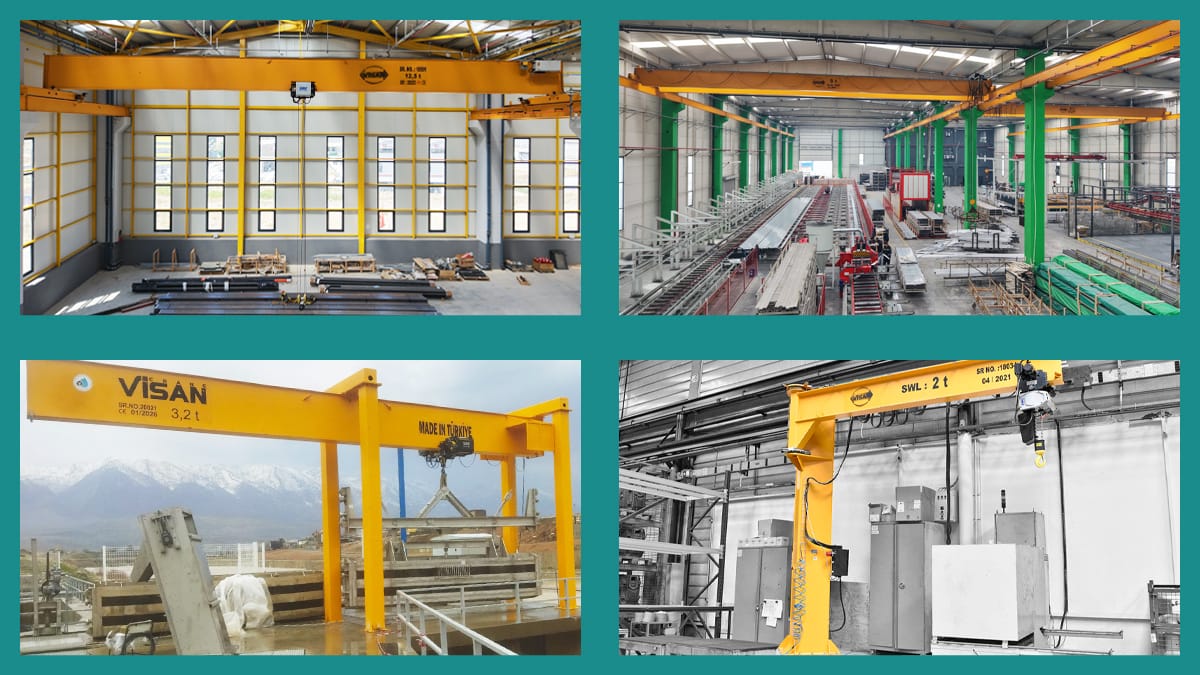
Crane selection is not just about choosing a lifting device; it is a strategic decision that directly impacts operational efficiency, workplace safety, maintenance costs, and return on investment. Selecting the wrong crane capacity, incorrect duty class, or an unsuitable system for your industry can increase failure rates, cause production losses, and create serious safety risks.
In this guide, you will find detailed answers to the most frequently searched questions such as:
- How to choose a crane according to your industry?
• Should you prefer an overhead crane or a mobile crane?
• How does the crane capacity calculate?
• What is the FEM classification and why is it important?
• Which crane systems are suitable for heavy industry?
1. Why Is Crane Selection a Critical Investment?
In industrial facilities, cranes are long-term investments typically used for 15–25 years. Therefore, proper engineering analysis at the beginning significantly affects the Total Cost of Ownership (TCO).
Incorrect selection may lead to:
- Insufficient lifting capacity
• Motor overloading
• High energy consumption
• Frequent maintenance requirements
• Production line downtime
Proper crane selection ensures:
- Increased operational efficiency
• Lower maintenance costs
• Improved workplace safety standards
• Longer equipment lifespan
2. Technical Criteria in Crane Selection (Detailed Engineering Approach)
2.1 How Does The Crane Capacity Calculate?
When calculating crane capacity, it is not only the load weight that matters. The following factors must be considered:
- Capacity (Q)
• Hook travel distance (Ce)
• Number of operations per hour (Ch)
• Total daily operating time (Ti)
• Lifting speed (V)
2.2 Lifting Height and Span Distance
Column spacing, beam span, and roof height within the facility are key determining factors for overhead crane systems, generally as follows:
- Up to 20 m building span → Single girder crane
• Over 20 m span → Double girder crane
• Localized area → Monorail crane or Jib crane
2.3 What Is FEM Classification?
FEM (Fédération Européenne de la Manutention) classification defines the duty intensity of a crane.
- Light duty (Workshop type)
• Medium duty
• Heavy duty
• Very heavy duty
Especially for heavy industry cranes, selecting the wrong FEM class can significantly shorten equipment lifetime.
2.4 Working Environment
Environmental conditions directly affect crane design:
- High temperatures
• Dusty environments
• Outdoor operation
• Chemical atmospheres
In such conditions, special motor insulation, enclosed gearbox systems, and protective coating applications are required.
3. Industry-Based Crane Selection Guide
3.1 Crane Selection for Industrial and Manufacturing Facilities
Target: crane selection for factories, industrial crane systems
In industrial facilities, fixed systems such as the following are generally preferred:
Recommended Systems:
- Single girder EOT crane
• Double girder EOT crane
• Monorail crane systems
• Jib crane
Why Overhead Cranes?
Overhead crane systems provide linear movement across the entire facility. They accelerate production lines and reduce the need for forklifts.
Advantages of double girder cranes:
- Higher load capacity
• Greater lifting height
• Suitable for heavy-duty operations
3.2 Crane Selection in Warehousing and Logistics
Target: warehouse crane systems, logistics crane solutions
Since space efficiency is critical in warehouses, electric overhead travelling cranes are generally preferred.
Advantages:
- No floor space loss
• Fast load transfer between racks
• Increased operational safety
3.3 Ports and Heavy Load Handling
Target: gantry crane, port crane
Port operations require high tonnage capacity and wide outreach.
Commonly Used Systems:
- Gantry crane
• Container handling cranes
These systems are designed to withstand outdoor operating conditions.
3.4 Energy, Steel, and Heavy Industry
The highest tonnage operations take place in these sectors.
Recommended Systems:
- Double girder EOT crane
• Heavy-duty gantry crane
• Process cranes
These cranes are designed for 24/7 operation and classified under heavy-duty service.
4. The Cost of Choosing the Wrong Crane
Selecting the wrong capacity or low-quality equipment may result in:
- Motor failures
• Wire rope breakage risk
• Workplace accident risk
• High maintenance costs
• Production losses
Therefore, the crane project engineering process requires professional expertise.
5. What Should the Crane Engineering Process Include?
- Site inspection
- Load capacity determination
- Duty class identification
- 2D/3D technical design
- Manufacturing
- Installation and commissioning
6. What Determines Crane Prices?
Crane prices vary depending on:
- Capacity
• Crane span distance
• Temperature conditions
• Duty classification
• Electrical and mechanical component selection
• Automation requirements
• Special design needs
Although low-cost cranes may seem advantageous in the short term, they can result in higher maintenance costs in the long run.
7. Why Is Choosing the Right Crane Partner Important?
Since crane investments are long-term, the experience of the manufacturer plays a critical role.
Visan Crane:
- Provides project-specific engineering solutions
• Manufactures according to European standards
• Offers nationwide installation and service across Turkey
• Produces long-lasting industrial crane systems
8. Frequently Asked Questions
How is crane capacity determined?
It is determined based on maximum load weight, daily lifting frequency, and safety factors.
Which crane is suitable for which industry?
Overhead cranes, jib cranes, and monorail cranes are suitable for industrial facilities. Gantry cranes are generally preferred for ports.
Why is FEM classification important?
It defines the crane’s working intensity and durability.
9. Conclusion: The Right Crane for the Right Industry
Each industry has different requirements. Therefore, crane selection must be carried out through technical analysis and a professional engineering process.
An investment made with the right capacity, the right system, and the right engineering approach will operate safely and efficiently for many years.
If you want to determine the most suitable crane system for your business, working with an expert team is the most reliable step.
10. Contact Us
To determine the most suitable crane solution for your business and request a quote, get in touch:
Website: www.visan.com.tr
Email: visan@visan.com.tr
Phone: +90 212 549 84 57